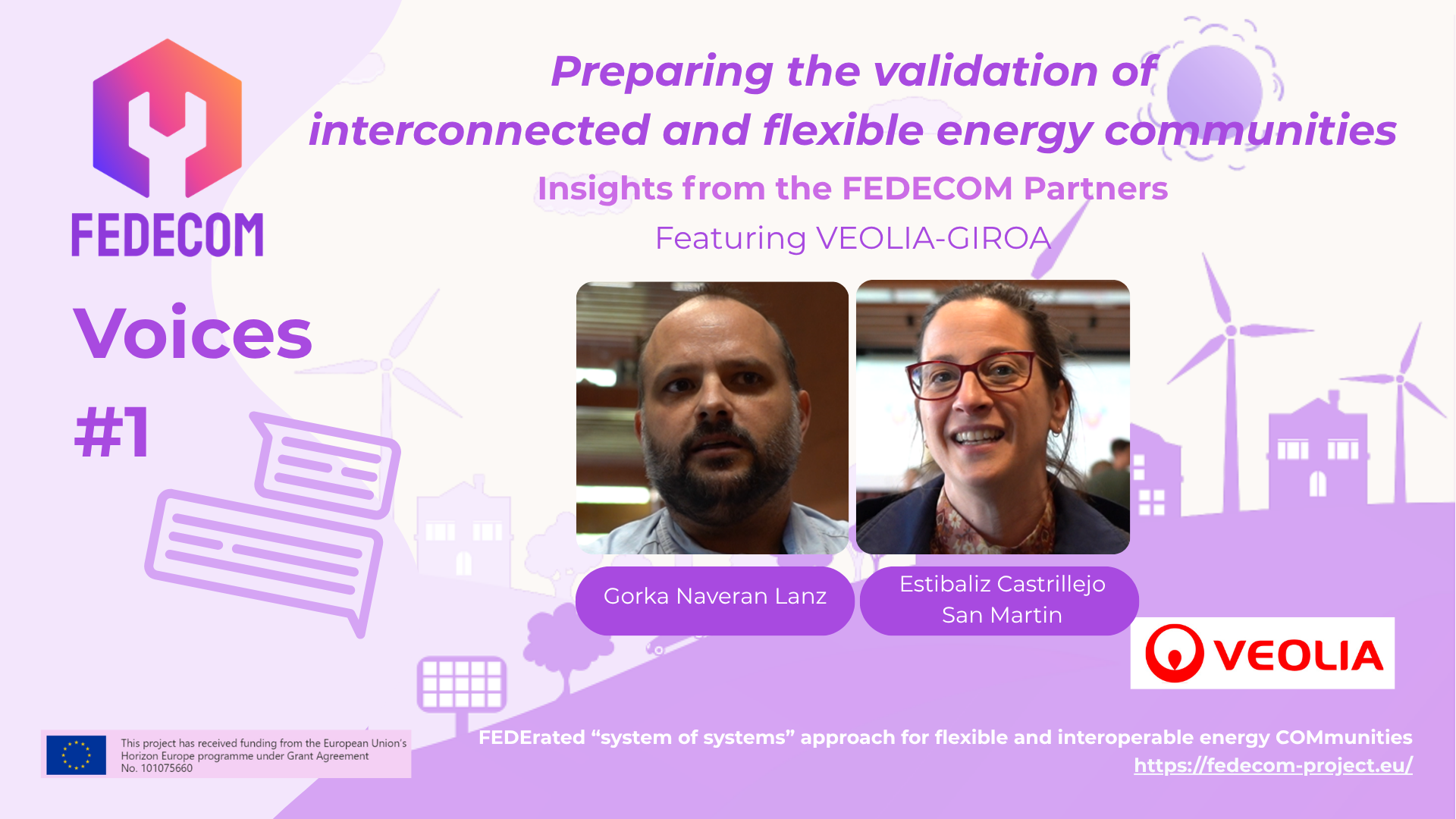
FEDECOM Voices is a new series of short project updates highlighting the work, achievements and perspectives of FEDECOM partners as the project progresses towards its final phase. Each edition gives the floor to a FEDECOM partner to share ongoing activities, recent achievements and future perspectives, helping showcase the collective efforts driving the project forward.
FEDECOM Enters a Decisive Phase Towards the Validation of Interconnected Energy Communities
Following the successful General Assembly held in April, which brought together consortium partners to review progress and prepare the next phase of implementation, the FEDECOM project is now entering a particularly important stage of its development. As technical deployments near completion across the demonstration sites, partners are now preparing the next stage of activities: validating how interconnected and flexible energy communities can operate in real-life conditions.
The General Assembly confirmed the strong progress achieved across the project, notably through the delivery of the Pilot Deployment Report (Deliverable D7.3), which provides a comprehensive overview of the deployment status of the FEDECOM solutions and demonstration sites and marks an important transition from system deployment towards large-scale validation and performance assessment. Discussions also highlighted the consortium’s commitment to ensuring the successful completion and long-term impact of the project, including the proposed extension currently under review as part of the ongoing amendment process.
As project coordinator and leader of Work Package 7, Veolia is currently preparing the upcoming validation campaign planned for this summer under Task 7.4 (Use case validation analysis and reporting). This phase represents a key milestone for FEDECOM as the project moves from deployment towards the demonstration of measurable impacts and operational performance.
To support this work, partners are currently defining the historical baselines using the International Performance Measurement and Verification Protocol (IPMVP) methodology. At the same time, the consortium is finalising the portfolio of flexible assets that will actively participate in local energy exchanges across the pilots. These assets include, among others, 40 kWh battery storage systems and heat pumps deployed in the Ur Beroa demonstration site, which will play a key role in testing flexibility services and local energy exchanges under real operating conditions.
These activities are at the heart of FEDECOM’s ambition to address one of the major challenges of the energy transition: enabling local energy markets both between and within energy communities. In the FEDECOM framework, prosumers are empowered to make real-time energy exchange decisions supported by demand forecasting tools, dynamic pricing mechanisms and secure blockchain-based transactions.
With most of the hardware deployment now close to completion, attention is increasingly turning towards one of the project’s most challenging steps: ensuring seamless integration between digital intelligence and physical energy assets. Current efforts focus on enabling Model Predictive Control (MPC) algorithms to execute automatic commands and interact with and control physical equipment, transforming advanced optimisation strategies into operational actions.
“With the deployment of hardware almost complete, our focus is now on IT integration so that Model Predictive Control (MPC) algorithms can execute automatic commands on physical equipment. The FEDECOM solution follows a true ‘System of Systems’ approach. By coupling electricity and heat through artificial intelligence, we can absorb renewable energy surpluses, relieve pressure on the grid and generate real energy savings.”
Gorka Naveran Lanz / Estibaliz Castrillejo San Martin, Veolia
This integration lies at the core of FEDECOM’s innovative “System of Systems” approach. By coupling multiple energy vectors, notably electricity and heat, and combining artificial intelligence, forecasting capabilities and flexibility services, FEDECOM aims to absorb renewable energy surpluses, reduce stress on electricity networks, improve local energy management and generate tangible energy savings.
As preparations for the validation campaign continue, FEDECOM is moving closer to demonstrating how interconnected, flexible and digitally enabled energy communities can contribute to a more resilient, efficient and citizen-centred energy system across Europe.
The coming months will be crucial in transforming years of research, development and deployment efforts into concrete evidence supporting the future replication, scalability and market uptake of energy communities across Europe.