As energy communities become increasingly interconnected, managing them efficiently requires more than simply producing and consuming renewable energy. It requires the ability to anticipate demand, coordinate multiple energy assets and allow different systems to exchange and understand information.
In this third edition of FEDECOM Voices, we meet TEKNIKER, a technology centre specialising in advanced energy systems, artificial intelligence and digital technologies for the energy transition.
Within FEDECOM, TEKNIKER is developing some of the digital building blocks needed to turn energy data into actionable intelligence – helping energy communities operate more proactively, efficiently and collaboratively while paving the way towards the federation of multiple energy communities.
From data to actionable intelligence
Energy communities bring together increasingly diverse resources, technologies, users and operational requirements. Managing this complexity means being able not only to understand what is happening now, but also to anticipate what is likely to happen next.
This is where forecasting and predictive optimisation become particularly important.
TEKNIKER has developed data-driven forecasting models capable of predicting thermal demand in several FEDECOM pilot sites. Using information including historical thermal demand and weather forecasts, these models can anticipate future energy needs and provide essential inputs for optimisation and energy management.
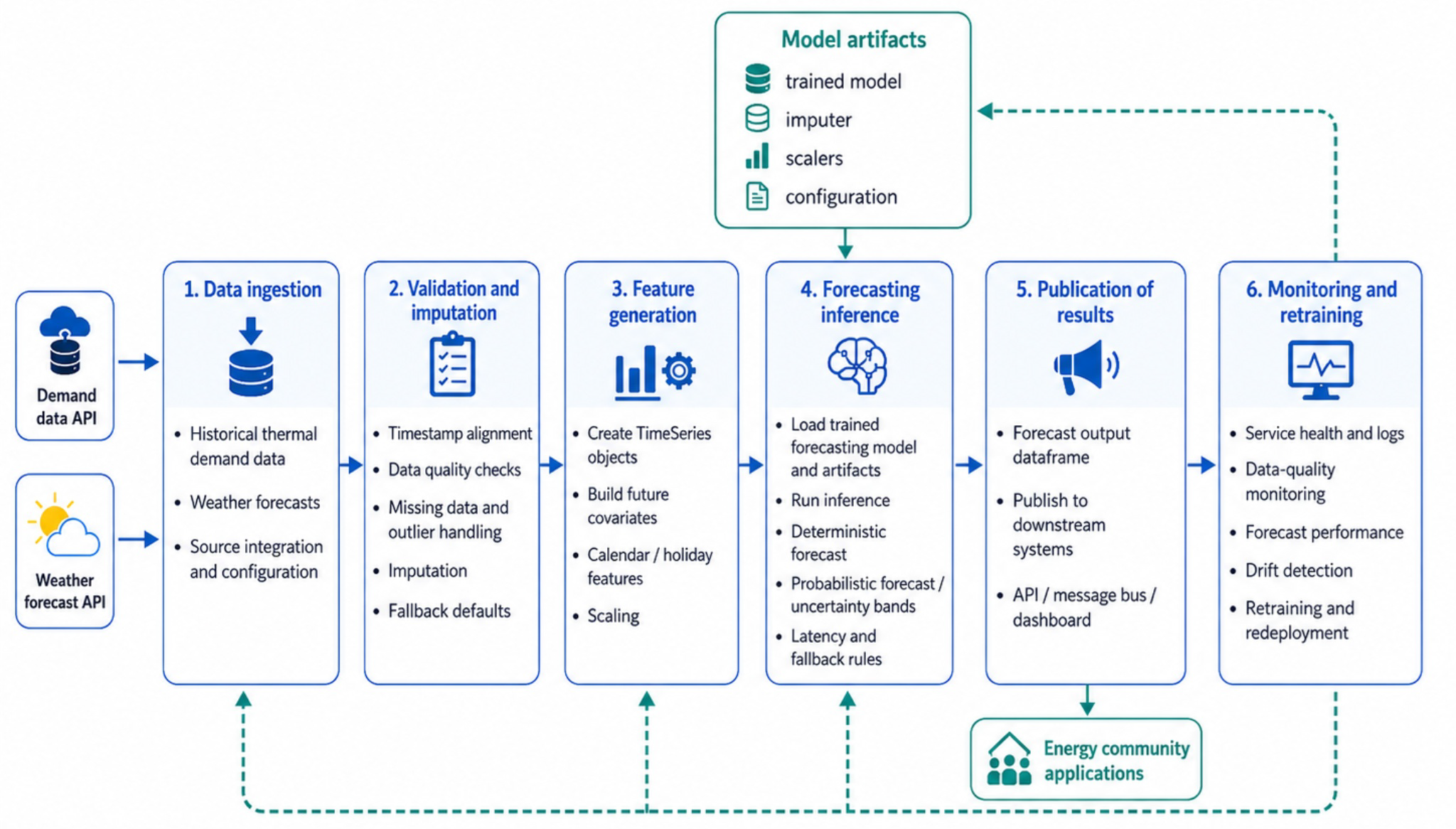
From data ingestion and validation to forecasting, publication and monitoring: the demand forecasting workflow developed by TEKNIKER within FEDECOM
Rather than simply reacting to changes in energy demand, predictive tools can therefore help communities prepare for them.
Moving from reactive to predictive energy management
Building on these forecasting capabilities, TEKNIKER has developed advanced Model Predictive Control (MPC) strategies for proactive energy management across different FEDECOM pilot sites.
These optimisation algorithms support applications ranging from building heating, ventilation and air-conditioning (HVAC) systems to district heating networks.
By considering expected demand, weather forecasts, renewable energy availability, system constraints and operational objectives, MPC strategies can anticipate future operating conditions and determine how available energy resources should be coordinated.
The objective is clear: operate energy systems proactively rather than reactively, improving efficiency and flexibility while maintaining user comfort and system performance.
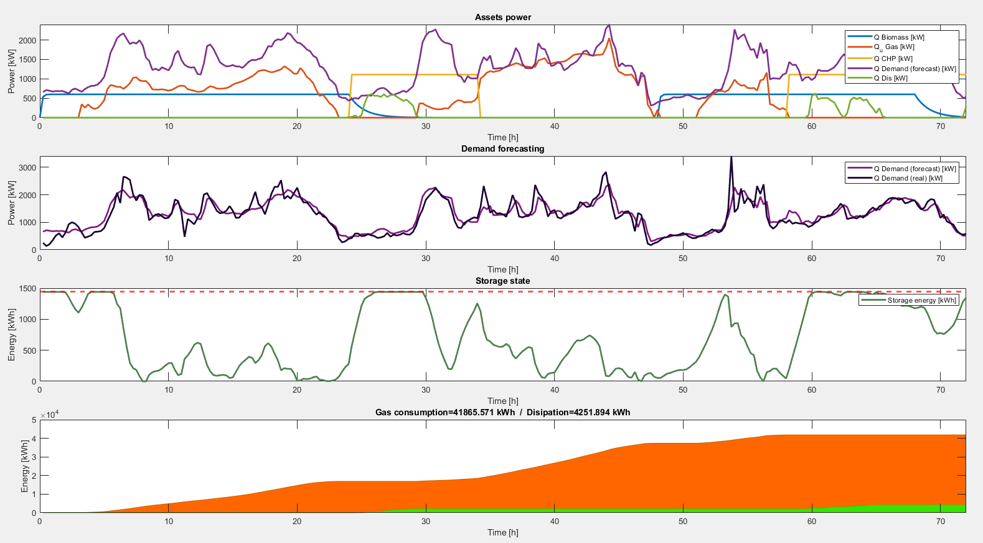
Example of Model Predictive Control results combining energy demand forecasting, different energy assets and storage management
This capacity to anticipate and optimise is particularly relevant as energy communities integrate more distributed renewable generation, storage and flexible energy resources.
But optimisation alone is not enough. For different tools, assets and communities to work together, they also need to understand one another.
Making energy systems speak the same language
Interoperability is therefore another essential part of TEKNIKER’s contribution to FEDECOM.
The challenge is significant. Energy communities can involve very different technologies, measurement systems, data structures and operational environments. If information is described differently by every system, integrating services and coordinating resources becomes considerably more difficult.
To address this, TEKNIKER has developed a semantic interoperability framework based on a modular ontology, together with associated REST APIs.
The ontology provides a common and standardised way of representing energy communities, their assets and their measurement systems while remaining sufficiently flexible to accommodate the specific characteristics of different FEDECOM pilots.
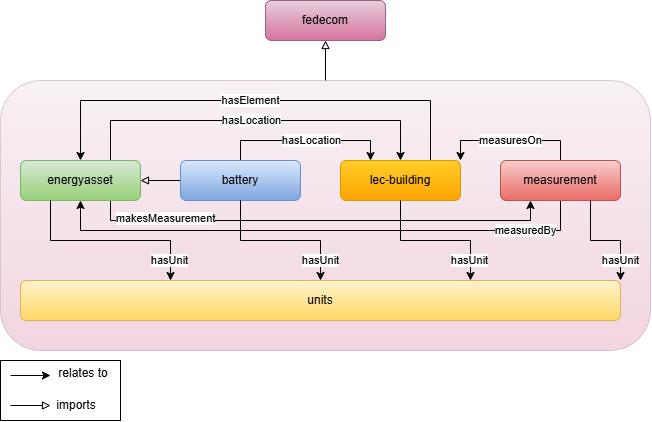
Modular structure of the FEDECOM ontology, providing a common representation of energy assets, buildings, batteries, measurements and units.
This common semantic framework enables project partners to access and exchange information through a shared data model, facilitating the integration of tools and services developed across FEDECOM.
The ontology has already been instantiated using FEDECOM data, while REST APIs have been developed to make this information accessible to project applications and services.
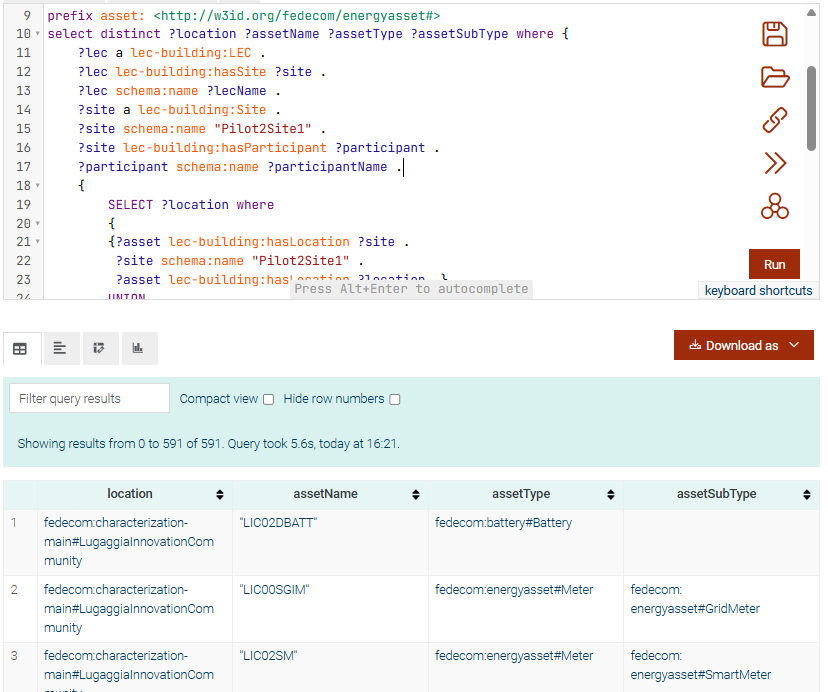
Example of querying FEDECOM energy asset information through the semantic interoperability framework developed by TEKNIKER
Forecasting, optimisation and interoperability are therefore not isolated developments. Together, they form complementary components capable of supporting more intelligent and coordinated energy management across energy communities.
From advanced algorithms to real-world energy communities
Developing sophisticated digital tools is only one part of the challenge.
Energy communities, district heating networks and building energy systems are rarely created from scratch. Instead, they are generally composed of existing infrastructures, control systems and operational practices that have evolved over time. Deploying predictive optimisation therefore also requires integration with existing control architectures, SCADA systems and building management systems.
Each pilot also has its own combination of energy assets, comfort requirements, operating schedules, control philosophies and flexibility opportunities.
One of the major lessons emerging from TEKNIKER’s work in FEDECOM is therefore that successful digitalisation depends not only on the performance of algorithms, but also on their ability to work within these real-world constraints.
This requires close cooperation with site operators and stakeholders to translate operational realities into models and control strategies that are technically feasible, robust and acceptable in practice.
It is precisely this connection between technological innovation and operational reality that will become increasingly important as FEDECOM moves into its next phase.
Towards validation in real operational environments
With the main technical components now developed, attention is increasingly turning towards their deployment and validation under real operating conditions.
TEKNIKER will support the deployment and validation of its forecasting, optimisation and interoperability tools within the FEDECOM pilot sites, assessing their contribution to energy efficiency, flexibility and operational performance.
Particular attention will be given to how these solutions interact with existing control systems and operational procedures – an essential step towards ensuring that advanced digital solutions can ultimately be adopted by real energy communities.
Beyond optimising individual assets, these developments contribute to a much broader ambition: enabling multiple energy communities to cooperate while maintaining their local autonomy.
Through forecasting, predictive optimisation and semantic interoperability, these developments contribute to the FEDECOM vision of federated energy communities, where local communities maintain their autonomy while benefiting from increased cooperation, flexibility and shared intelligence.
At the same time, TEKNIKER continues to disseminate the knowledge generated through FEDECOM, with scientific publications already produced and additional journal papers and conference contributions under preparation.
The FEDECOM Voice
“Developing advanced algorithms is only part of the challenge. Real impact comes when those algorithms can work within existing infrastructures, respect operational constraints and support better decisions for community operators and energy users.”
Susana López
Lead Researcher, Thermal Systems Team, TEKNIKER
Through the combined efforts of all partners, FEDECOM continues to demonstrate how interoperable, flexible and federated energy communities can accelerate Europe’s energy transition.