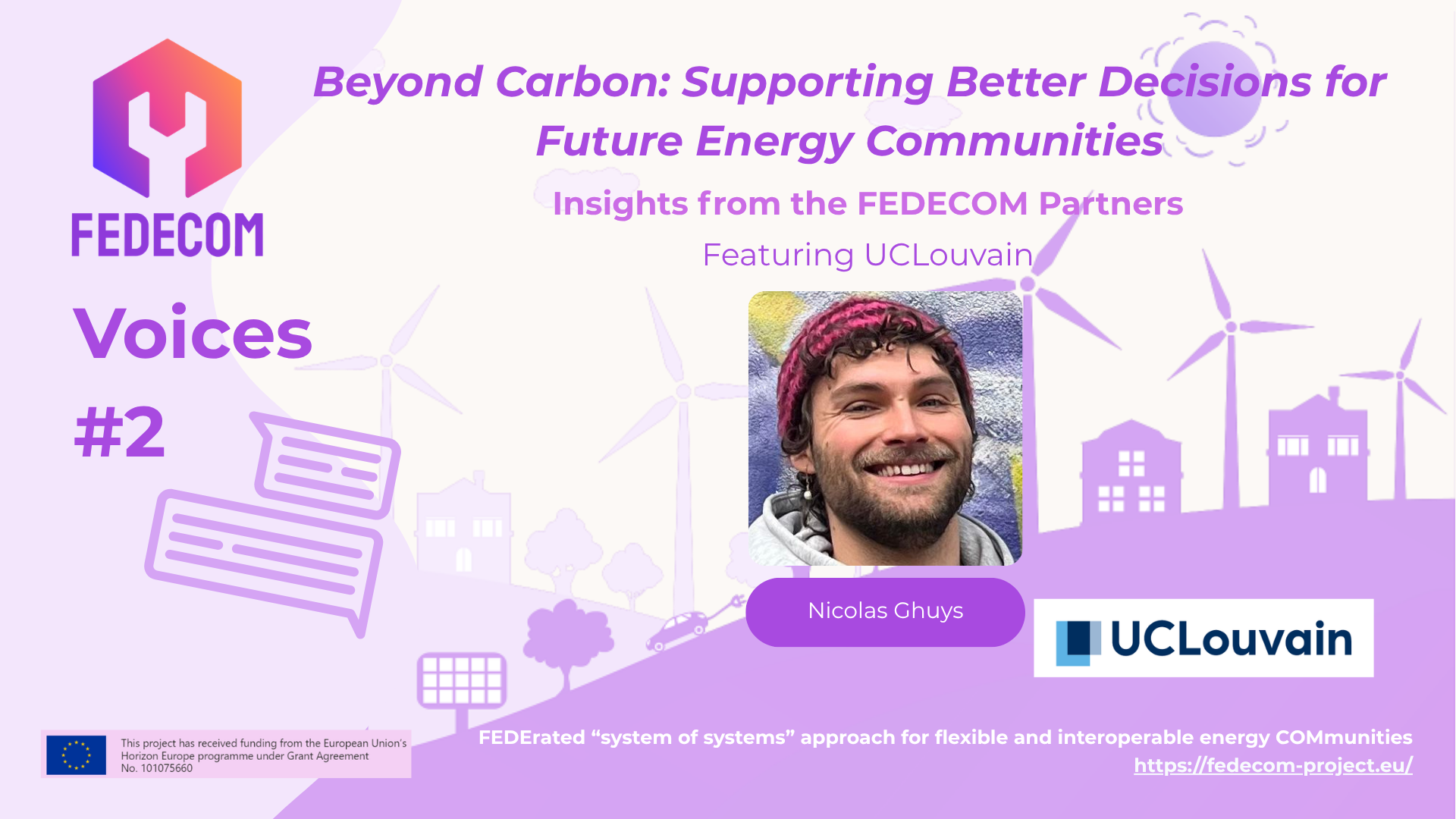
Through FEDECOM Voices, we invite project partners to share the ideas, experiences and innovations that are helping shape the future of energy communities. In this edition, we feature UCLouvain and its work on developing more comprehensive approaches to sustainability assessment and decision-making.
Energy communities are becoming an increasingly important part of Europe’s energy transition. They offer new opportunities for citizens, local authorities and businesses to actively participate in the production, management and sharing of energy.
However, designing future energy systems is becoming increasingly complex. Decisions cannot be based solely on costs or carbon emissions. They must also consider resource use, environmental impacts, system performance, resilience and long-term sustainability.
Within FEDECOM, UCLouvain plays a key role in helping address this challenge.
UCLouvain brings extensive expertise in techno-economic analysis, environmental impact assessment and energy system modelling across scales ranging from local energy communities to national energy systems. The team leads FEDECOM’s work on system modelling and contributes to the development of advanced methodologies that support better decision-making for future energy communities.
By combining expertise in Life Cycle Assessment (LCA), energy system optimisation and multi-criteria evaluation approaches and decision-support methodologies, UCLouvain helps ensure that energy solutions developed within FEDECOM can be assessed from multiple perspectives rather than through a single indicator.
Over the past months, the team has continued to strengthen and disseminate the methodologies developed within FEDECOM through scientific publications, international conferences, workshops and collaborations with the wider research community. These activities contribute to improving the visibility, robustness and long-term impact of the project’s results.
A key focus of UCLouvain’s work is the development of approaches that go beyond traditional carbon-centred assessments. While reducing greenhouse gas emissions remains essential, future energy systems must also operate within broader environmental limits and contribute to sustainable development objectives.
This perspective is particularly relevant for energy communities and local decision-makers, which often need to balance environmental ambitions, economic viability, technological choices and social benefits. Providing decision-makers with more comprehensive assessment tools can help support better-informed choices and avoid unintended environmental trade-offs.
Looking ahead, UCLouvain will continue contributing to the development of FEDECOM methodologies and decision-support tools, helping energy communities better understand the long-term implications of different energy pathways and investment choices.
“The future of energy communities is not only about reducing emissions. It is about making informed decisions that respect environmental limits while delivering affordable, resilient and socially beneficial energy solutions.”
Nicolas Ghuys, UCLouvain team
Through the combined efforts of all partners, FEDECOM continues to demonstrate how interoperable, flexible and federated energy communities can accelerate Europe’s energy transition.