From battery performance to battery lifetime: modelling smarter storage for future energy communities
Battery energy storage is an essential component of more flexible energy communities. By storing locally generated renewable electricity and making it available when demand exceeds generation, batteries can help communities better balance their energy systems. But understanding how a battery performs today is only part of the equation: its degradation over time directly affects long-term performance and investment decisions.
In this edition of FEDECOM Voices, Fraunhofer Institute for Solar Energy Systems ISE (Fraunhofer ISE) shares its work within FEDECOM on developing flexible battery and battery ageing models to evaluate operational strategies and long-term battery performance in energy communities.
Fraunhofer ISE: developing solutions for future energy systems
Fraunhofer ISE develops technologies for efficient and environmentally friendly energy systems, covering areas such as photovoltaics, energy storage, hydrogen technologies and intelligent energy systems.
Within FEDECOM, Fraunhofer ISE’s contribution comes from its Smart Grids department, which works on integrating renewable energy sources, energy storage technologies and digital solutions into future electricity networks.
One of the research group’s areas of focus is the planning and optimisation of storage-based local energy systems. To support the planning and operation of battery energy storage in decentralised energy systems, the team develops simulation and optimisation tools.
Within FEDECOM, this expertise is being applied to the development of battery and battery ageing models, enabling different operational strategies to be evaluated while also considering the long-term performance of batteries in energy communities.
Developing a flexible framework for battery modelling
Fraunhofer ISE’s work within FEDECOM has focused on developing a flexible methodology for modelling and simulating battery energy storage systems and their ageing behaviour within energy communities.
The simulation framework has been designed to be modular and easily adaptable, allowing battery systems to be parameterised for different technologies and applications.
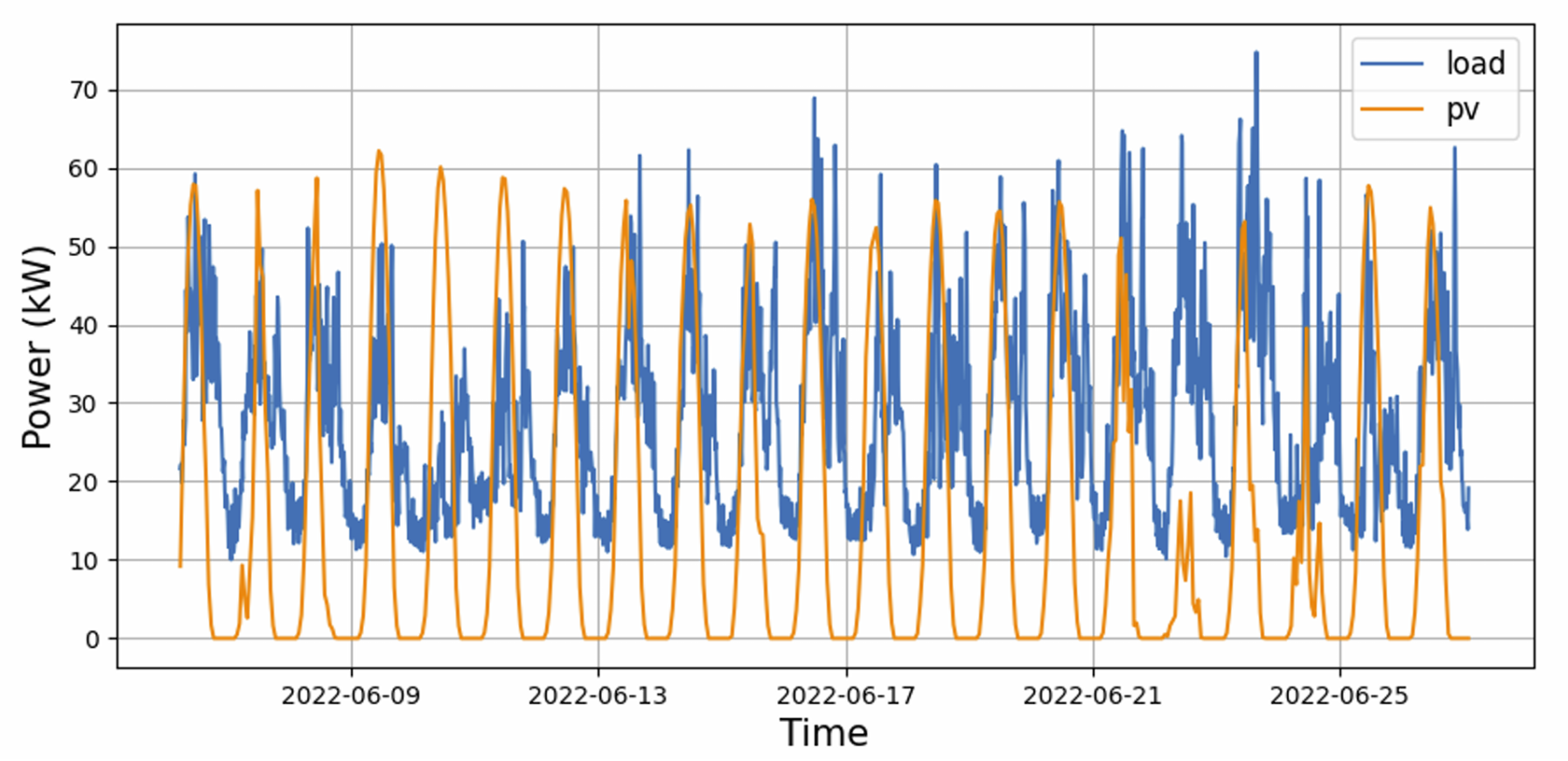
Example load and PV input data for battery simulation. © Fraunhofer ISE
A key aspect of the approach is its extensibility. Different battery ageing assumptions and modelling approaches can be integrated with minimal effort, making it possible to evaluate alternative scenarios and incorporate future developments.
This flexibility provides a solid foundation for analysing the long-term performance of battery storage under different operating conditions.
Balancing simplicity and realism
A key achievement has been the development of a battery storage simulator that strikes a balance between simplicity and realism.
While remaining lightweight and computationally efficient, the model is capable of capturing complex storage behaviour, including different battery ageing mechanisms.
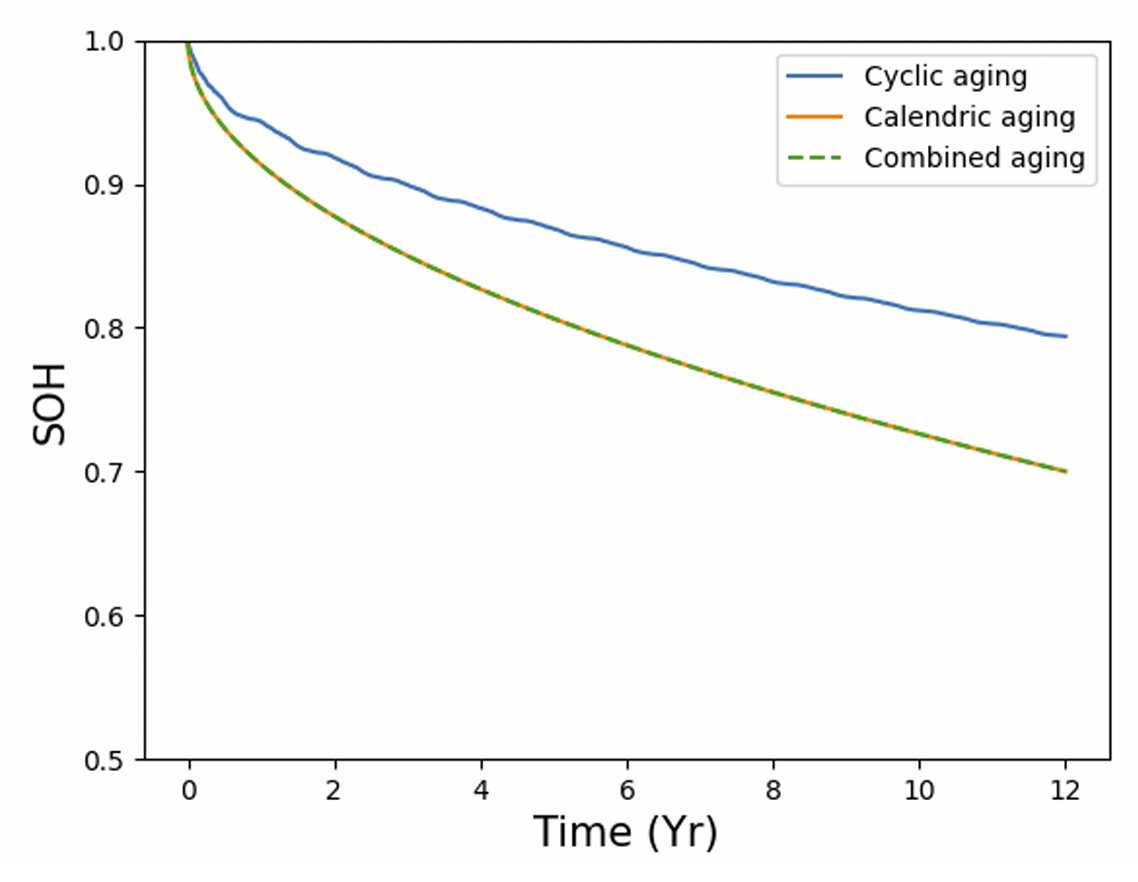
Ageing of an example battery used to increase self-consumption of PV-generated electricity. © Fraunhofer ISE
This combination makes the simulator a versatile testbed for developing and evaluating advanced control and energy management algorithms. At the same time, its computational efficiency means that it remains fast enough to support large-scale simulations and scenario studies.
Its modular structure also allows new battery technologies, parameter sets and ageing models to be incorporated as research and technologies evolve.
Why battery ageing matters for energy communities
Battery energy storage can play a key role in increasing the flexibility of energy communities by storing locally generated renewable electricity and making it available when demand exceeds generation.
However, battery degradation directly affects both long-term performance and investment decisions.
Looking only at short-term operation therefore provides an incomplete picture when assessing storage solutions for energy communities.
By combining realistic operational modelling with ageing simulations, Fraunhofer ISE’s work within FEDECOM helps stakeholders better understand the trade-offs between battery utilisation, lifetime and system performance.
These insights can support better-informed decisions and contribute to the design of energy communities that are more resilient, cost-effective and sustainable.
“Understanding how batteries perform not only today, but throughout their entire lifetime, is essential for designing energy communities that remain efficient, reliable and economically sustainable. Our goal is to provide simulation tools that support better decisions for the energy systems of tomorrow.”
Tobias Rohrer – Fraunhofer ISE